Tono · Historia · TécnicaTone · History · Technique
El tono vive en tus manos: de la válvula al navegador
Tone Lives in Your Hands: From the Vacuum Tube to the Browser
Setenta años de guitarristas persiguiendo un sonido. Qué aprendieron en el camino, por qué tu tono en casa a veces decepciona, y cómo cambiarlo esta misma noche.
Seventy years of guitarists chasing a sound. What they learned along the way, why your tone at home sometimes disappoints, and how to change that tonight.
Por el equipo de Magnus Rig · 8 minutos de lecturaBy the Magnus Rig team · 8 min read
Cada ampli cuenta una época. Elegirlo es elegir una historia.Every amp tells the story of an era. Choosing one is choosing a story.
Hay un momento que todo guitarrista conoce. Enchufás, rasgueás un acorde y algo pasa: el sonido no sale del parlante, sale de vos. La nota se sostiene, responde a la presión de los dedos, se ensucia cuando atacás fuerte y se limpia cuando aflojás. En ese instante entendés que el instrumento no termina en la guitarra. Termina en el amplificador.
Esta nota es un viaje por ese descubrimiento: cómo se formó el sonido que hoy reconocemos en miles de discos, qué hace que un tono funcione, y por qué hoy, por primera vez, podés tener todo eso en una pestaña del navegador.
IEl accidente más feliz de la música
Los primeros amplificadores de guitarra no fueron pensados para distorsionar. Fueron diseñados para algo mucho más modesto: hacer que una guitarra se escuchara por encima de una banda. La meta de los ingenieros era un sonido limpio, fiel, sin colores.
Pero los músicos no siempre usan las herramientas como fueron pensadas. Al subir el volumen al máximo, las válvulas empezaban a saturar: la señal se comprimía, se redondeaba y aparecían armónicos nuevos. Lo que en teoría era un defecto sonaba, en la práctica, vivo. Cálido. Peligroso.
La distorsión no fue un invento. Fue un descubrimiento: el sonido de un equipo empujado más allá de sus límites.
Desde entonces, la historia del tono de guitarra es la historia de ese límite. Cada generación encontró una forma nueva de empujarlo.
IILas grandes eras del tono
Si escuchás con atención los discos de las últimas décadas, aparecen capítulos bien definidos. Cada uno nació de una necesidad musical y de un equipo que la resolvió.
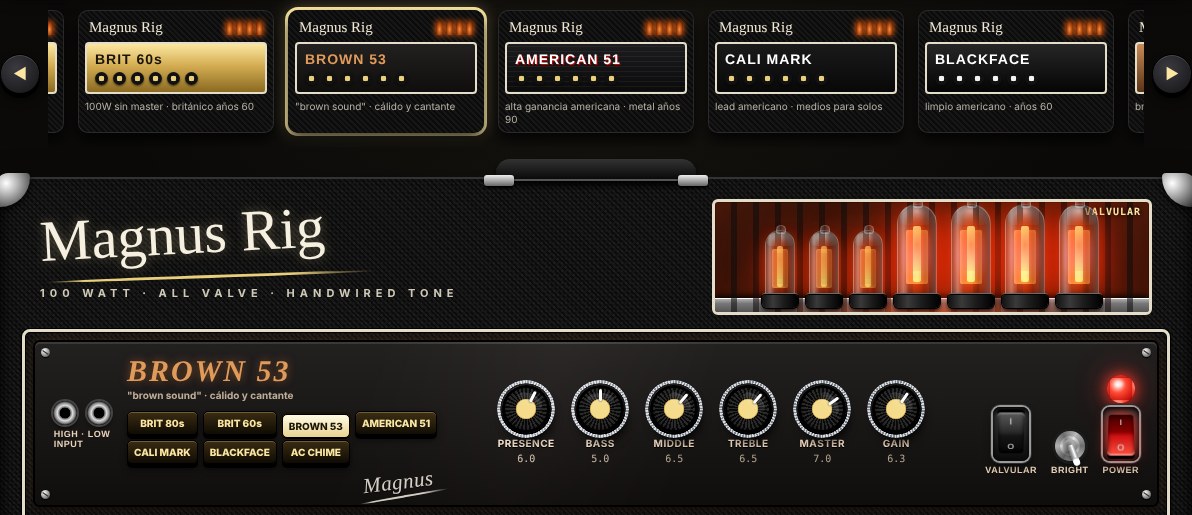
AÑOS 60El crunch británico. Amplificadores con válvulas de potencia que saturan temprano y medios hacia adelante. El acorde suena grande, áspero y con aire.AÑOS 60–70El limpio americano. Brillo, rebote y una reverb de resortes que se volvió marca registrada del surf, el country y el blues urbano.FINES DE LOS 70El "sonido marrón". Un ampli británico llevado al límite, con un timbre cálido, cremoso y lleno de armónicos que redefinió la guitarra rock.AÑOS 80La alta ganancia. Etapas de preamplificación en cascada, saturación desde el ampli mismo y el nacimiento del solo virtuoso tal como lo conocemos.90 EN ADELANTEEl metal moderno. Graves ajustados, ataque preciso, puertas de ruido y riffs en afinaciones cada vez más bajas.
Lo fascinante es que ninguna de estas eras reemplazó a la anterior. Todas siguen vivas, y un buen guitarrista sabe moverse entre ellas como un pintor entre colores.
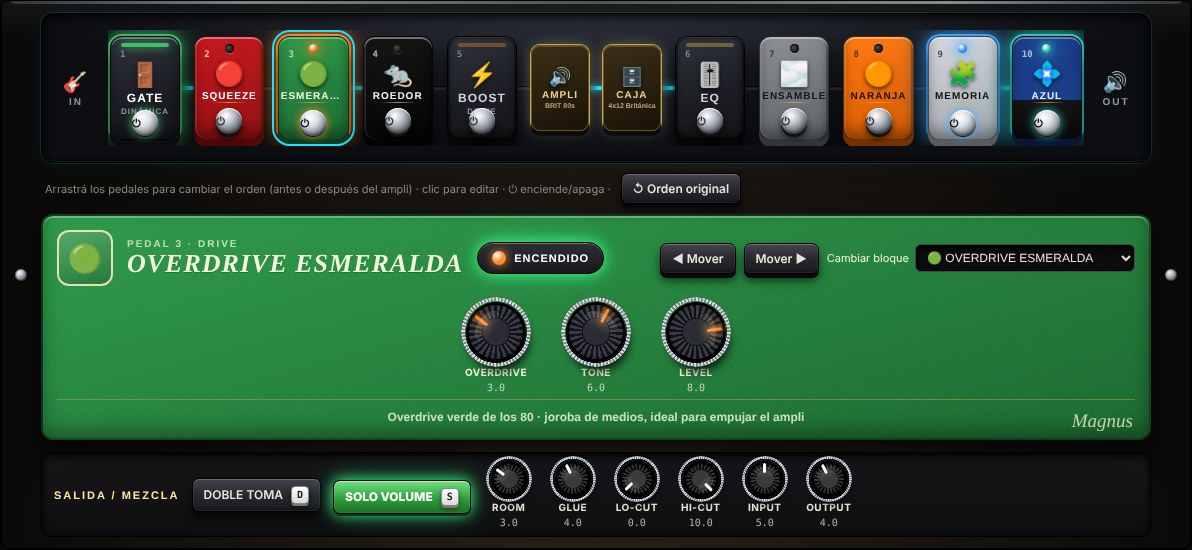
El orden de los pedales también es composición.
IIIPor qué el tono en casa decepciona
Muchos guitarristas viven la misma frustración: el sonido que imaginan no es el que sale de su equipo en casa. No es falta de talento. Hay tres razones técnicas.
El volumen. Los amplificadores de válvulas cantan cuando trabajan fuerte. A volumen de departamento, a las once de la noche, la mayoría suena chato.
El parlante y el micrófono. El sonido de los discos no es el del ampli solo: es el del ampli dentro de una caja, con un parlante moviendo aire y un micrófono ubicado a pocos centímetros. Esa cadena le da forma a casi la mitad del tono.
La ganancia. Para compensar la falta de volumen, solemos subir la distorsión. Y ahí el sonido se vuelve un bloque: pierde definición, ataque y dinámica.
IVCinco claves para un gran tono
1. Menos ganancia de la que creés
Muchos sonidos legendarios tienen bastante menos distorsión de la que parece. La sensación de potencia viene de la compresión del ampli y de la firmeza con que se toca. Bajá la ganancia hasta que cada nota del acorde se distinga, y recién ahí subila de a poco.
2. Los medios son tus amigos
Sacar los medios suena impresionante cuando tocás solo, pero desaparece cuando entra la banda. Los medios son el lugar donde vive la guitarra en una mezcla. Si querés que se te escuche, dejalos.
3. La caja es la mitad del sonido
Probá el mismo ampli con distintas cajas y parlantes: vas a sentir que cambiaste de equipo. Una caja cerrada de cuatro parlantes empuja graves; una abierta respira y suena más suelta.
4. El orden de los pedales importa
La regla clásica funciona por algo: compresión y saturación antes del ampli; modulación, delay y reverb después. Romperla también es válido, siempre que sea a propósito.
5. El tono está en las manos
Un buen equipo amplifica lo que hacés. Tocá con dinámica: atacá fuerte en el coro, aflojá en la estrofa y bajá el volumen de la guitarra para limpiar el sonido. Un ampli bien ajustado responde como un instrumento.
Probalo esta noche
Elegí un ampli crunch, poné la ganancia en 4 y el master alto. Tocá un acorde suave y después uno fuerte. Si la diferencia te sorprende, ya encontraste el secreto: el sonido responde a vos.
VDel estudio al navegador
Durante décadas, conseguir estos sonidos exigía cuartos llenos de equipos, horas de prueba y mucho volumen. El modelado digital cambió el juego al reproducir el comportamiento de los circuitos. Más recientemente, las capturas con redes neuronales aprendieron a imitar la respuesta de un ampli real con un nivel de detalle que antes parecía imposible.
El último paso fue el más silencioso: los navegadores modernos ya pueden procesar audio en tiempo real con muy poca latencia. Eso significa que un rig completo, con amplificadores, pedales, cajas y un estudio para grabar, puede vivir en una pestaña. Sin instalar nada, desde cualquier computadora.
Así nació Magnus Rig: de la idea de que el sonido que imaginás no debería depender del equipo que tenés, sino de lo que querés decir con la guitarra.
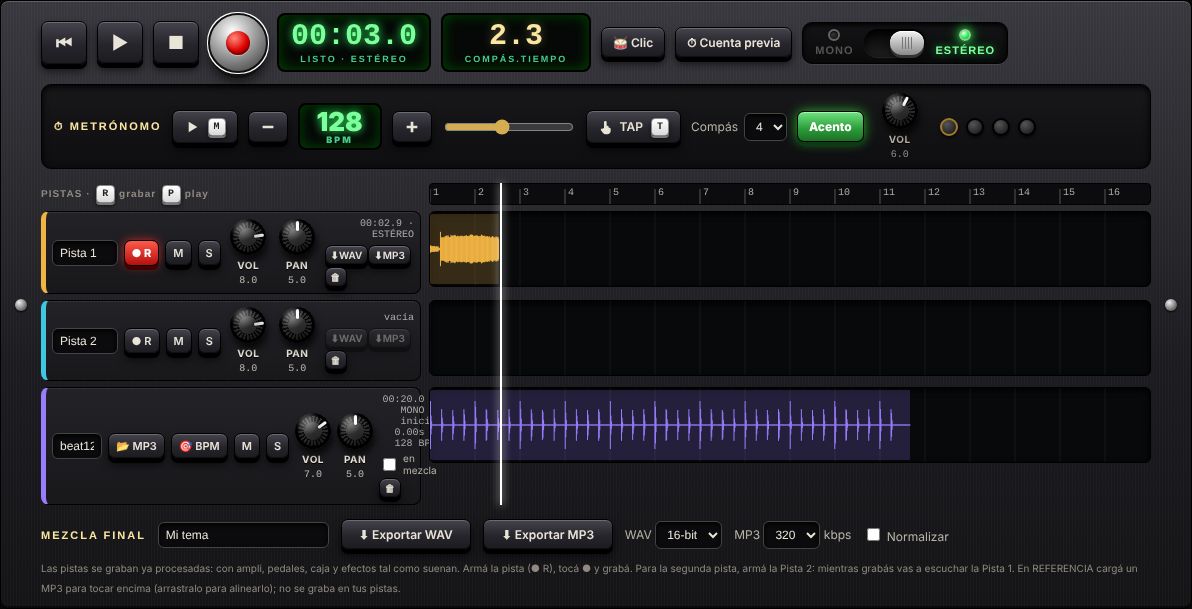
De una idea a una maqueta, sin salir del navegador.
VIUna última idea
Los guitarristas que admiramos no tenían el mejor equipo. Tenían una idea clara del sonido que buscaban y la paciencia de perseguirlo. Las herramientas cambian; lo que permanece es esa búsqueda.
Enchufá. Tocá un acorde. Escuchá qué te devuelve. Y empezá a construir tu sonido.
Magnus Rig
Amplis, pedales y un estudio completo en tu navegador. Probalo gratis.
There is a moment every guitarist knows. You plug in, strum a chord, and something happens: the sound doesn't come out of the speaker, it comes out of you. The note sustains, answers the pressure of your fingers, breaks up when you dig in and cleans up when you ease off. In that instant you understand that the instrument doesn't end at the guitar. It ends at the amplifier.
This is a journey through that discovery: how the sound we recognize on thousands of records came to be, what makes a tone work, and why today, for the first time, you can have all of it in a browser tab.
IMusic's happiest accident
The first guitar amplifiers were never meant to distort. They were designed for something far more modest: to make a guitar heard over a band. The engineers wanted a clean, faithful, uncolored sound.
But musicians rarely use tools the way they were intended. Turned all the way up, the tubes began to saturate: the signal compressed, rounded off, and new harmonics appeared. What was in theory a flaw sounded, in practice, alive. Warm. Dangerous.
Distortion was never invented. It was discovered: the sound of gear pushed past its limits.
Ever since, the story of guitar tone has been the story of that limit. Each generation found a new way to push it.
IIThe great eras of tone
Listen closely to the records of the last decades and clear chapters emerge. Each was born from a musical need and a piece of gear that answered it.
THE 60sBritish crunch. Amps with power tubes that break up early and push the mids forward. Chords sound big, raw and full of air.60s–70sAmerican clean. Sparkle, bounce and a spring reverb that became the signature of surf, country and city blues.LATE 70sThe "brown sound". A British amp pushed to the edge, with a warm, creamy, harmonically rich voice that redefined rock guitar.THE 80sHigh gain. Cascaded preamp stages, saturation from the amp itself, and the birth of the virtuoso solo as we know it.90s ONWARDModern metal. Tight lows, precise attack, noise gates and riffs in ever-lower tunings.
The fascinating part is that none of these eras replaced the one before. They are all still alive, and a great guitarist moves between them like a painter between colors.
The order of your pedals is composition, too.
IIIWhy tone at home disappoints
Many guitarists share the same frustration: the sound in their head isn't the sound coming out of their gear at home. It isn't a lack of talent. There are three technical reasons.
Volume. Tube amps sing when they work hard. At apartment volume, at eleven at night, most of them sound flat.
Speaker and microphone. The sound on records isn't the amp alone: it's the amp inside a cabinet, a speaker moving air and a microphone placed a few centimeters away. That chain shapes almost half of the tone.
Gain. To make up for the missing volume we crank the distortion. And that's when the sound turns into a block: it loses definition, attack and dynamics.
IVFive keys to great tone
1. Less gain than you think
Many legendary sounds carry far less distortion than they seem to. The feeling of power comes from the amp's compression and from how firmly you play. Lower the gain until every note of the chord is distinct, then bring it up slowly.
2. The mids are your friends
Scooped mids sound impressive when you play alone, but they vanish the moment the band comes in. The mids are where the guitar lives in a mix. If you want to be heard, keep them.
3. The cabinet is half the sound
Try the same amp through different cabinets and speakers: it will feel like new gear. A closed four-speaker cab pushes low end; an open-back one breathes and sounds looser.
4. Pedal order matters
The classic rule works for a reason: compression and drive before the amp; modulation, delay and reverb after. Breaking it is valid too, as long as you mean it.
5. Tone is in the hands
Good gear amplifies what you do. Play with dynamics: dig in on the chorus, ease off on the verse, and roll back your guitar's volume to clean up the sound. A well-set amp responds like an instrument.
Try it tonight
Pick a crunch amp, set the gain to 4 and the master high. Play a soft chord, then a hard one. If the difference surprises you, you've found the secret: the sound responds to you.
VFrom the studio to the browser
For decades, getting these sounds meant rooms full of gear, hours of trial and error and a lot of volume. Digital modeling changed the game by reproducing how circuits behave. More recently, neural network captures learned to imitate the response of a real amp in detail that once seemed impossible.
The last step was the quietest: modern browsers can now process audio in real time with very low latency. That means a complete rig, with amps, pedals, cabinets and a studio to record in, can live in a tab. Nothing to install, from any computer.
That is how Magnus Rig was born: from the idea that the sound you imagine shouldn't depend on the gear you own, but on what you want to say with your guitar.
From an idea to a demo, without leaving the browser.
VIOne last thought
The guitarists we admire didn't have the best gear. They had a clear idea of the sound they were after and the patience to chase it. Tools change; that search is what remains.
Plug in. Play a chord. Listen to what comes back. And start building your sound.
Magnus Rig
Amps, pedals and a full studio in your browser. Try it free.